
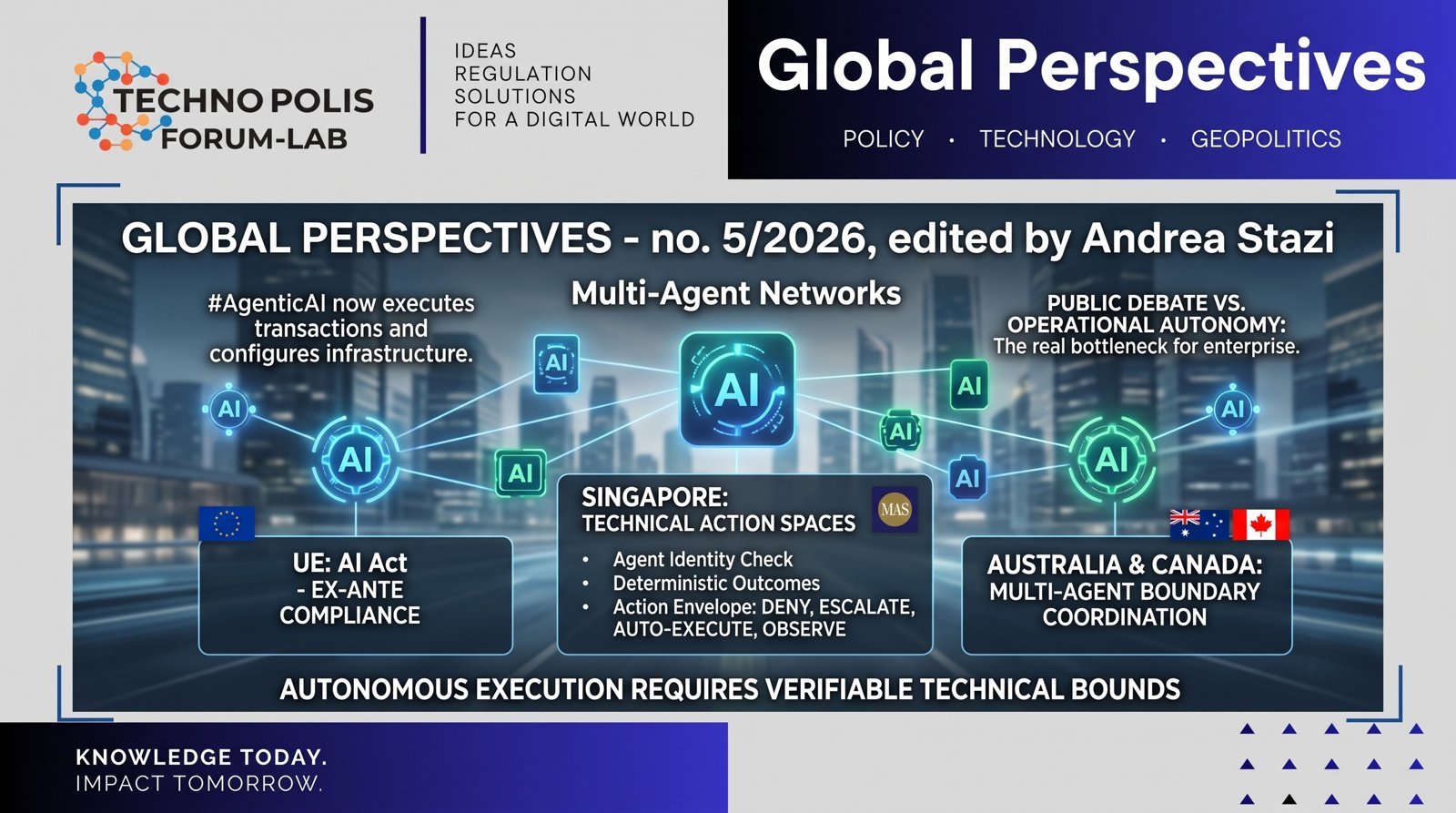
Regulatory discussions surrounding artificial intelligence have spent considerable resources debating distant existential hazards.
In corporate departments, engineering teams, and supervisory bodies, practical frictions stem from software autonomy: agentic AI.
Generative tools output text or code upon discrete user prompts.
Agentic systems receive high-level targets, build execution plans, access persistent memory, call APIs, and coordinate with peer systems across corporate boundaries.
Under these execution speeds, continuous manual human approval becomes an impossible bottleneck.
Leaving systems unconstrained exposes infrastructure to unverified actions, data leakage, and unauthorized transactions.
International authorities have begun publishing actionable frameworks tailored to operational execution.
In Singapore, the Infocomm Media Development Authority established principles isolating the action space of autonomous tools, mapping permission levels directly to system reversibility.
Building on this approach, the Monetary Authority of Singapore released Safeguards for Agentic Finance at Runtime (SAFR) under its BuildFin.ai program.
SAFR introduces a runtime governance layer: every outbound call moves inside a Governance Envelope evaluated against an explicit mandate.
The system disposition engine forces deterministic verdicts before execution occurs: Deny, Escalate, Auto-Execute, or Observe.
Approvals at one execution stage carry no residual authority into subsequent calls, and actions are logged to tamper-resistant audit trails.
Other regional bodies are addressing inter-system friction.
In August 2026, the Australian Department of Industry, Science and Resources alongside its AI Safety Institute issued Risks and Controls for Multi-Agent Systems, analyzing compounding failures, cross-organizational feedback loops, and unintended machine collusion.
The Treasury Board of Canada Secretariat introduced operational guidelines for public sector deployments, restricting agents to read-only states until strict behavioral sandboxing is demonstrated.
Joint international guidance from agencies such as CISA and international cyber partners outlines defense-in-depth adoption criteria for critical infrastructure operators.
Simultaneously, technical security standards, led by the OWASP Top 10 for Agentic Applications, identify vulnerabilities including indirect prompt injection and context poisoning.
These frameworks reveal divergent regulatory philosophies.
The European Union structures governance through horizontal statutory harmonization under Regulation (EU) 2024/1689 (the AI Act) and the GDPR.
High-risk systems require pre-market conformity assessments, systemic risk documentation, and ex-ante technical documentation.
This framework guarantees high fundamental rights protections.
It faces structural friction when applying static pre-market verification to non-deterministic systems whose behavioral scope mutates through multi-agent collaboration.
Singapore, Canada, and Australia favor technical co-regulation.
Rather than expanding statutory definitions, their agencies define technical control planes that anchor existing civil liability and sector-specific fiduciary duties.
When an agent exceeds calibrated transaction limits inside an execution envelope, the deploying enterprise retains direct liability for failing to enforce runtime boundaries.
This divergence influences market dynamics.
The United States maintains rapid frontier model deployment driven by private capital, balanced by reactive agency oversight and litigation.
This environment accelerates experimentation, but leaves enterprises exposed to contractual and operational uncertainty.
European markets risk administrative overhead if implementing guidance fails to supply dynamic testing standards.
The strategic challenge for digital policymakers is closing the gap between statutory compliance and machine execution.
Without standardized protocols for agent identity, capability delegation, and runtime sandboxing, enterprise deployment will concentrate within closed proprietary platforms that can absorb systemic liability.
Translating high-level governance into machine-enforceable runtime architecture is the operational baseline for trusted autonomy.
Sources and References:
Infocomm Media Development Authority (IMDA) & AI Verify Foundation, Model AI Governance Framework (Expanded to Agentic Systems), Singapore, 2024–2026.
Monetary Authority of Singapore (MAS), Safeguards for Agentic Finance at Runtime (SAFR), BuildFin.ai White Paper, July 2026.
Australian Government - Department of Industry, Science and Resources & AI Safety Institute, Risks and Controls for Multi-Agent Systems, August 10, 2026.
Cybersecurity and Infrastructure Security Agency (CISA) et al., Careful Adoption of Agentic AI Services, May 2026.
Treasury Board of Canada Secretariat, Guide on the Use of Agentic AI Systems in the Public Service, 2026.
OWASP GenAI Security Project, OWASP Top 10 for Agentic Applications for 2026, December 2025.
European Parliament and Council of the European Union, Regulation (EU) 2024/1689 (AI Act).