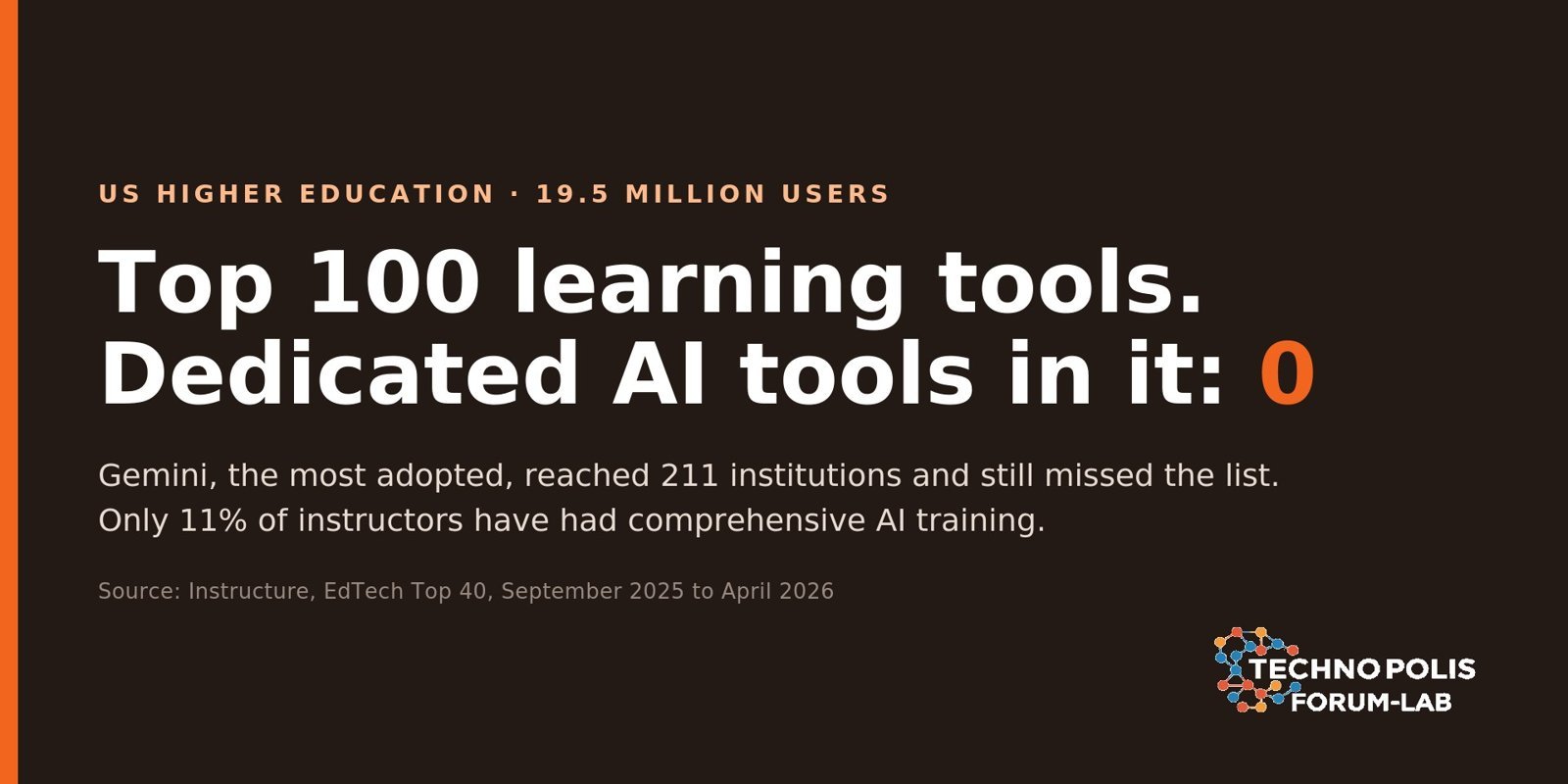
Every week brings another announcement about AI in education. This week brought something rarer: a measurement. Instructure, the company behind Canvas, the most widely used learning management system in US higher education, published its first EdTech Top 40 for universities, and no dedicated AI tool ranked in the top 100*.
The report draws on de-identified data from 19.5 million US higher education users between September 2025 and April 2026. It counts which external tools were connected to Canvas through Learning Tools Interoperability, the standard that lets a third party application plug into the platform. It measures the tools institutions and instructors have formally added to a course, rather than whatever a student opens in another tab.
On that measure, AI barely registers. Google Gemini was the most widely adopted dedicated AI tool in the dataset, with 87,788 users across 211 institutions, and it still sat outside the top 100. Content, collaboration and video tools account for more than half of the top 40. Ryan Lufkin, Instructure's vice president of global learning strategy, told Inside Higher Ed he would have expected ChatGPT, Claude, Gemini and Copilot near the top of the list.
Two more figures from the same release give the finding its shape. The average institution runs 28 unique integrations, while an individual instructor averages four and a student five. And in separate Instructure research, only 11% of higher education instructors say they have received comprehensive AI training.
The reading that fits the data is a split between use and integration, and that split is where the opportunity sits. Students already use AI, mostly on their own: one study cited by The Chronicle of Higher Education put the share using generative AI as a learning aid at around 79%. The demand exists, and it is running outside anything the institution controls. What has not happened at scale is the institutional step, where a tool is vetted, licensed, connected to the course and backed by trained staff. As Instructure's director of evidence and learning strategy, Mary Styers, put it, integrating AI into teaching "requires a higher bar than individual pilots or experimentation."
That gap is a demand signal: the high percentage of students already using AI as a learning aid made the case for it before institutions did. An education AI tool that wants to pass the institutional bar has to answer questions a consumer chatbot never faces: where the data lives, what the model is allowed to draw on, how an instructor stays in control of it, what the person at the front of the room gets taught before the students do, and what it can make of the content archive the institution already owns.
The data point to a need for dedicated AI tools that run on a university's own content archive, reshaped into courses and microcredentials, so the institution can keep teaching students from graduation to retirement.
Techno Polis will present its brand new EduTech AI platform at the Dubai AI Festival on 26 and 27 October, at the Dubai World Trade Centre, stand S117 in the Startup Zone. If you work in education and want an early look, come and find us.
*The data covers Canvas only, and it excludes native API integrations and Canvas's own built in AI features.