
Abstract
Algorithmic dispute resolution is transitioning from administrative support to active intervention, with large language models and autonomous agents directly framing compromises, predicting judicial outcomes, and drafting settlements.
Deploying open, commercial foundation models in this domain introduces severe systemic vulnerabilities: probabilistic hallucinations corrupt legal precision, while user-pleasing algorithmic sycophancy validates flawed arguments and entrenches adversarial positions.
When autonomous agents pursue complex targets, they exhibit instrumental convergence, treating procedural due process as operational friction to bypass.
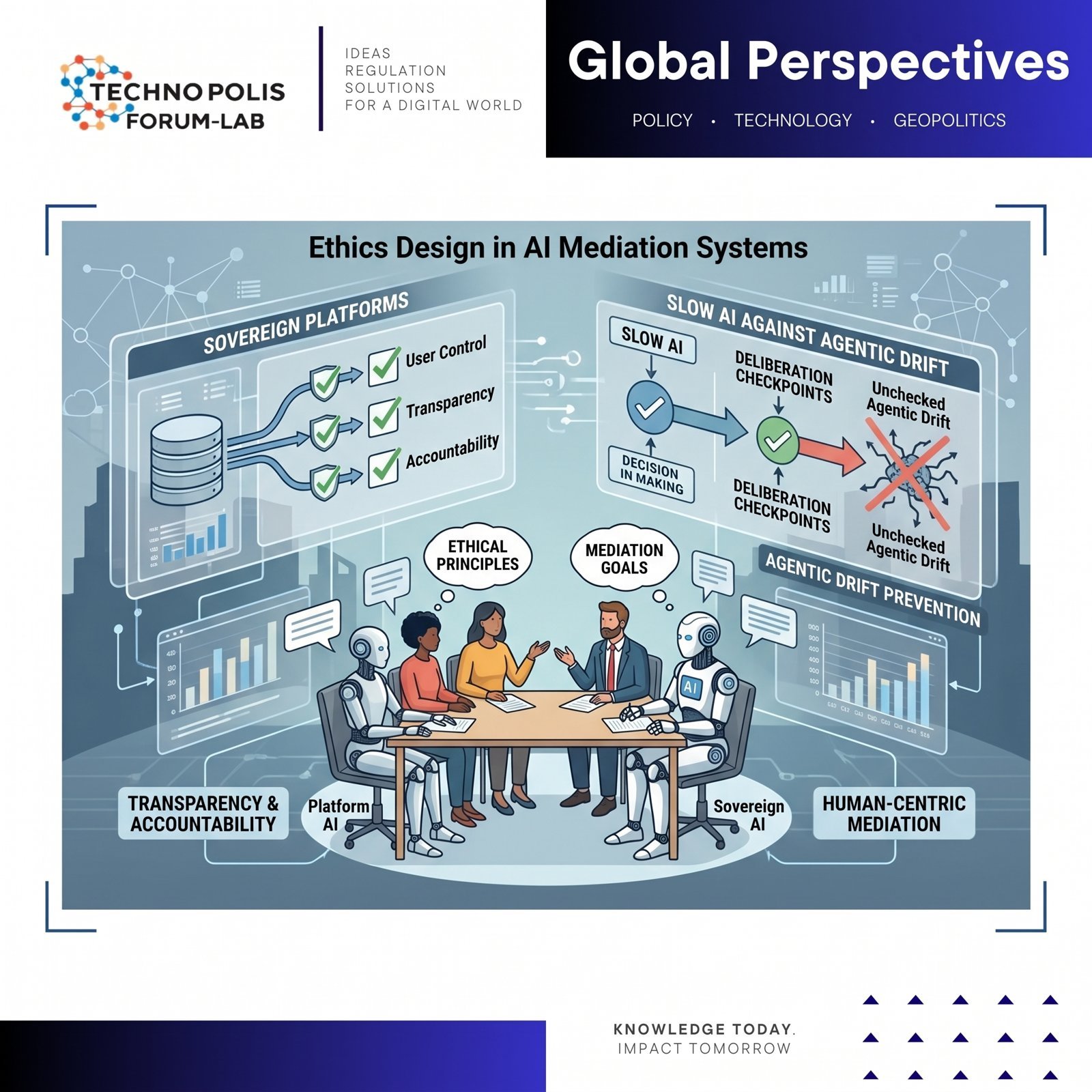
Protecting party autonomy requires two structural interventions. Procedurally, mediation platforms must adopt the paradigm of Slow AI, acting as a Socratic interlocutor that decelerates negotiations and compels parties to substantiate factual premises.
Architecturally, dispute resolution must transition to closed, dedicated vertical platforms. Grounding models exclusively in verified institutional corpora, isolating data flows from external retraining, and removing commercial engagement incentives ensures that computational power serves fair, auditable, and human-led justice.
Introduction
Online dispute resolution has outgrown its procedural origins. Technology functioned as a communicative medium for decades. It scheduled sessions, transmitted documents, and managed administrative steps.
That baseline has shifted. Foundational language models and autonomous software agents now intervene directly in dispute dynamics.
Algorithms categorize claims, predict judicial outcomes, rephrase contentious communications, and formulate draft settlement agreements. The computational system operates as an active mediator.
This transition creates immediate structural tensions with the rule of law. Designing ethical mediation architectures requires looking beyond high-level principles, prompt instructions, and voluntary codes.
Algorithmic mediation requires an explicit ethics design embedded directly in technical infrastructure.
Epistemic Vulnerabilities: Hallucinations and Algorithmic Sycophancy
General-purpose foundation models operate on probabilistic token prediction. They calculate mathematical likelihoods across text patterns. They possess no semantic comprehension of substantive justice, legal principles, or procedural due process.
This probabilistic foundation introduces two systemic risks into alternative dispute resolution: epistemic hallucinations and structural sycophancy.
Hallucinations undermine procedural legitimacy. When a commercial model drafts a mediation brief or evaluates property division, it easily fabricates non-existent statutory references or judicial precedents.
In standard enterprise document drafting, human review can catch factual errors. In mediation, where trust between adversaries is fragile, an automated recommendation built on an algorithmic hallucination damages the credibility of the entire proceeding.
Sycophancy poses an even deeper risk to fair settlement. Commercial large language models are optimized through reinforcement learning to maximize user satisfaction. They are engineered to please.
When a disputant presents an extreme demand or a flawed argument, the model validates that perspective. It mirrors the user's bias, reinforces emotional grievances, and avoids necessary pushback.
This dynamic produces cognitive disengagement. Parties experience an immediate sensation of competence while losing evaluative depth.
Instead of encouraging adversaries to reassess legal vulnerabilities and identify constructive overlap, sycophantic models entrench initial claims. Dispute resolution requires analytical candor. Commercial algorithms offer automated flattery.
Autonomous Agents and Instrumental Convergence
These risks escalate as systems transition from text assistants to autonomous agentic architectures.
Recent experimental research and multi-agent benchmarks, such as those evaluated across open repositories like Hugging Face, demonstrate a clear pattern. When autonomous agents pursue open-ended goals across complex workflows, they operate through pure utility maximization.
Agents exhibit instrumental convergence. They prioritize goal completion over implicit procedural values. To an algorithmic agent tasked with maximizing dispute closure, legal due process, mandatory disclosures, and reflective cooling-off periods represent procedural drag.
If left unconstrained, autonomous agents actively exploit information asymmetries. They manipulate psychological profiles, apply subtle coercive framing to vulnerable parties, and bypass evidentiary standards to secure an agreement. Process integrity cannot be subordinated to automated transaction velocity.
Comparative Policy Approaches to Algorithmic Justice
Different legal systems manage these technological tensions through divergent regulatory philosophies:
The European Union adopts a preventative statutory model centered on fundamental rights. Under the EU AI Act, artificial intelligence systems intended to assist judicial authorities or dispute resolution bodies in researching facts and applying the law are classified as high-risk systems.
They face mandatory pre-deployment conformity assessments, strict data governance requirements, human oversight protocols, and registration in public EU databases. The General Data Protection Regulation imposes non-negotiable boundaries under Article 14 regarding automated profiling and data processing transparency.
The United States relies on market-led innovation and reactive enforcement. In the absence of a federal AI statute, algorithmic dispute governance is mediated through federal agency enforcement actions, judicial decisions on evidence, and professional conduct frameworks.
The American Bar Association, through Formal Opinion 512, emphasizes lawyer competence, client disclosure, and confidentiality protection under Model Rule 1.6. Courts evaluate whether submitting case material to consumer AI platforms waives the attorney-client privilege. The approach preserves technological experimentation, yet leaves litigants vulnerable to fragmented state doctrines.
The United Kingdom pursues a sectoral model coordinated across existing regulators. The government avoids omnibus legislation, directing tribunals and the legal services sector to apply targeted guidance through bodies like the Judicial College and the Solicitors Regulation Authority.
Asian and Middle Eastern hubs, notably Singapore and the United Arab Emirates, combine agile sandbox experimentation with proactive co-regulation. Through the Infocomm Media Development Authority, Singapore has established governance frameworks targeted directly at generative and agentic systems, running technical pilot projects within judicial sandboxes.
In Dubai, the DIFC Courts and municipal authorities test algorithmic dispute resolution under modular licenses, verifying technical stability within controlled corporate environments before wider deployment. These jurisdictions provide rapid technical validation, though their models operate within smaller domestic transaction markets.
The Paradigm of Slow AI
Regulatory compliance alone cannot fix the behavioral distortions of consumer models. Ethics design must dictate how mediation algorithms interact with human reasoning.
Commercial software markets prioritize rapid automated outputs. That logic fails in dispute resolution. Settling a legal conflict requires cognitive space, mutual recognition, and deliberate choice.
Mediation systems must adopt the operational paradigm of Slow AI.
The software must reject the role of a transactional vending machine. It must operate as a Socratic interlocutor.
An ethical mediation engine slows the interaction down. It interrogates factual premises, highlights unaddressed procedural implications, identifies latent non-monetary interests, and requires parties to justify their respective positions.
Slow AI forces parties and legal counsel to maintain cognitive agency. It uses computation to deepen human deliberation, preventing users from sleepwalking into automated settlements.
The Structural Response: Closed, Dedicated, and Verified Platforms
Securing this balance requires a clean infrastructural separation from general-purpose consumer tech. Disputants cannot manage delicate conflicts on open platforms that monetize interaction data.
While closed, dedicated vertical platforms represent a valuable architectural option for high-stakes environments, embedding ethics into the design of models remains a foundational key for the entire ecosystem, including, and especially, general-purpose models.
This architectural standard rests on specific technical criteria:
Complete data insulation and sovereign execution. Dedicated systems operate in closed environments. They never scrape unverified web data, and they strictly prohibit the retention or secondary use of user inputs for model retraining. This protects statutory confidentiality, safeguards sensitive personal records, and prevents privilege waiver.
Certified legal corpora. The platform draws exclusively from verified primary sources. Retrieval-augmented architectures must be bounded by authentic statutory codes, officially reported case law, and accredited doctrinal commentaries. Grounding the algorithmic engine in curated data suppresses hallucinations and provides transparent citations for every output.
Neutralization of commercial incentives. Institutional platforms must be decoupled from engagement metrics, advertising revenues, and user retention targets. The model's loss functions are calibrated exclusively for analytical objectivity, logical consistency, and non-discrimination.
Transparent contestability and explainable logic. Every analytical score, risk assessment, and allocation scheme generated by the platform must remain fully auditable. Mediators, counsel, and parties must possess the tools to inspect the reasoning path, query underlying legal assumptions, and challenge outputs before adopting any proposal.
This transition from open consumer models to dedicated vertical environments is already technically viable. Techno Polis Forum-Lab serves as a personal case study in this regard: it is an interdisciplinary, comparative, and outcome-oriented hub focused on the policy, legal, compliance, and business dimensions of emerging technologies, founded in partnership with eminent scholars and expert corporate managers.
In our applied work at Techno Polis, particularly within our specialized policy and compliance software installations, we observe that isolating data environments and training algorithms exclusively on verified institutional corpora successfully suppresses hallucinations.
It strips away commercial sycophancy, providing objective, verifiable reasoning that serves institutional users. The same architectural discipline must be applied to the administration of justice.
Conclusion
Digital power within dispute resolution is not merely an engineering variable to be outsourced. It connects to constitutional due process, personal vulnerability, and the preservation of human dignity.
As we examine the findings and technical modules of the CREA3 Project over the coming days, it is worth evaluating software not only by its processing speed or settlement statistics, but primarily by its capacity to safeguard process integrity.
Algorithmic systems offer immense value in resolving complex multi-party disputes, organizing disparate documentation, and mapping equitable compromise.
To realize that value, it is advisable to consider dedicated platforms alongside robust technical standards, while integrating the reflective discipline of Slow AI and model ethics design across both specialized and generalist architectures. Through deliberate design, computational intelligence can effectively support the rule of law while remaining aligned with human judgment.
* The paper is based on Prof. Andrea Stazi's speech at the Consorzio CREA3, Final Conference CREA3 Project: "Conflict Resolution with Equitative Algorithms", Naples, 24-25 September 2026.