
1. Introduction and Global Regulatory Context
International discussions concerning artificial intelligence governance remain trapped between opposing regulatory philosophies.
The European Union pursues ex-ante harmonization centered on fundamental rights and risk mitigation, while the United States prioritizes market-driven flexibility and innovation velocity.
Major Asian and Middle Eastern jurisdictions balance national security controls with targeted industrial incentives and modular testing environments.
As U.S. President Donald Trump and Chinese President Xi Jinping convene at the White House to negotiate bilateral AI safety dialogues and risk-mitigation hotlines, the limitations of zero-sum regulatory competition become starkly apparent.
Overcoming this deadlock may require moving beyond the pursuit of uniform legal export. A promising path could involve evaluating the available strategic options and considering a synthesis based on industrial safety standards and agile regional testing.
The first strategic option on the table is the rigid statutory model. Proponents advocate for comprehensive ex-ante legislative harmonization, establishing strict prohibitions and mandatory compliance burdens across all economic sectors.
While this approach provides legal certainty and robust fundamental rights protection, it fails when applied across divergent geopolitical blocs.
Major economic competitors view comprehensive statutory export as an extraterritorial imposition, leading directly to regulatory fragmentation and diplomatic stalemate.
Enforcement under this model relies heavily on administrative penalties and centralized judicial oversight, which can lag behind rapid algorithmic iterations.
The second option is the market-driven flexible model. This approach relies on voluntary risk management frameworks, industry-led guidelines, and reactive enforcement through antitrust or consumer protection litigation.
Proponents argue that avoiding prescriptive mandates preserves innovation velocity and corporate agility. However, this framework lacks the predictability and systemic risk assurance necessary to manage frontier artificial intelligence models capable of autonomous execution across critical infrastructure.
Enforcement remains post-hoc and uncertain, leaving developers exposed to shifting judicial interpretations and regulatory ambiguity.
The third option, and a potential strategic synthesis explored in our analysis, combines technical safety standards with agile regional testing environments.
Rather than attempting to harmonize entire legal codes, policymakers could consider borrowing governance architectures from systemic high-impact industries that global powers already recognize.
2. The Civil Aviation Precedent for Frontier Models
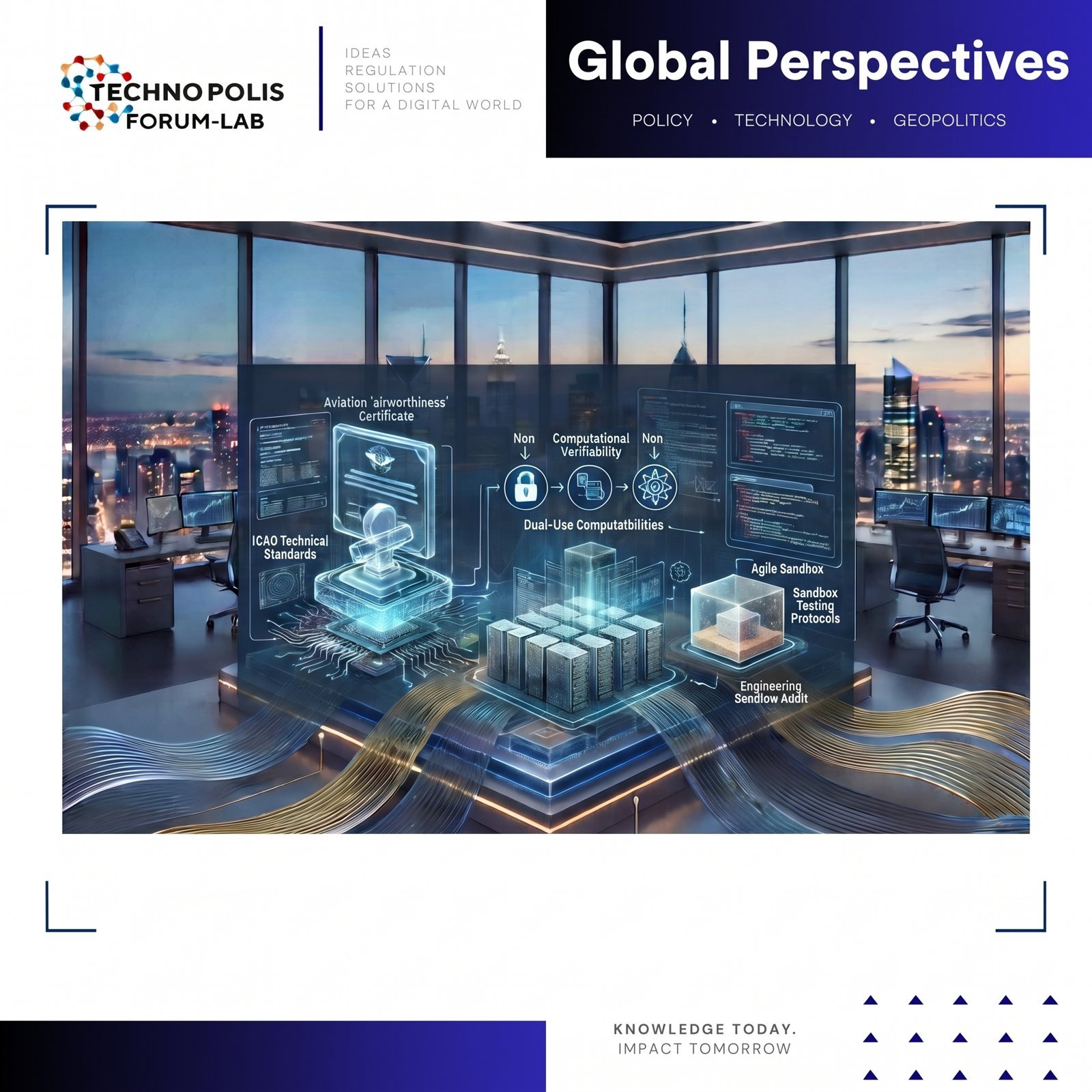
Civil aviation governance under the International Civil Aviation Organization does not enforce a single state design law for aircraft engineering. Instead, it establishes minimum technical safety standards, global interoperability protocols, and mutual recognition of national airworthiness certifications.
Applying this framework to frontier artificial intelligence could shift the regulatory focus away from content monitoring toward pre-deployment technical validation.
Rather than legislating abstract parameters, international bodies might establish standardized safety protocols and red teaming benchmarks.
Developers could verify structural safety against these quantitative stress tests before public deployment, potentially supporting systemic reliability while maintaining algorithmic research flexibility.
3. Non-Proliferation and Computational Bottlenecks
Managing physical bottlenecks in advanced computing infrastructure requires adapting mechanisms from non-proliferation regimes and dual-use technology controls. Semiconductor supply chains and massive supercomputing clusters represent the primary geopolitical leverage points in modern technology policy.
Replacing fragmented unilateral export bans with multilateral inspection protocols and objective thresholds based on floating-point operations could offer a way to transform trade restrictions into verifiable security guarantees.
Aligning computational monitoring with transparent auditing standards might link national security directly with engineering verifiability.
4. The Singapore and Dubai Sandbox Model
To explore operationalizing these global standards without creating unnecessary friction, policymakers might look to the co-regulatory frameworks piloted in Singapore and the United Arab Emirates.
Jurisdictions such as Dubai and Singapore utilize structured regulatory sandboxes and modular technical licensing.
These environments allow testing of algorithmic systems against engineering metrics, offering a potential middle ground that could align US commercial innovation requirements and Chinese stability objectives while supporting accountability.
5. Enforcement Mechanisms and Institutional Oversight
Enforcement within such a hybrid framework could shift from punitive post-hoc litigation toward collaborative technical auditing.
Independent inspection bodies and certified laboratories could verify compliance against objective engineering baselines rather than subjective legal interpretations.
This decentralized supervisory model may help prevent regulatory capture while maintaining transparent accountability across international borders.
6. Economic Incentives and Market Structure Implications
Adopting a hybrid model of this nature could adjust the economic incentives governing technological development.
While traditional prescriptive regulation can impose uniform fixed compliance costs that disproportionately burden smaller market entrants, an infrastructure-based safety benchmark combined with agile sandboxes might allow scalable compliance tied to computational scale and systemic risk thresholds.
Startups and advanced research laboratories could then validate their models within controlled environments without incurring prohibitive legal overhead.
Furthermore, policy alignment across international trade corridors could encourage cross-border investment in secure computing infrastructure.
When venture capital and corporate treasury funds observe clear, technically verifiable safety standards rather than ambiguous administrative discretion, capital deployment might accelerate.
The resulting market structure could support competitive diversity while maintaining baseline security.
7. Conclusion
Ultimately, navigating the future of digital sovereignty requires moving beyond zero-sum regulatory competition and administrative overreach.
As leaders discuss bilateral safety frameworks at the current White House summit, combining standardized industrial safety benchmarks with agile sandbox testing proposes an adaptable, cooperative architecture for global artificial intelligence governance across major markets.