
Introduction
Media and democracy are at a historical crossroads. Looking at the trajectory of contemporary policy debates, the traditional framing - “Media & Democracy”, or increasingly “Media versus Democracy” - almost invariably assumes a defensive, reactive posture: how to shield democratic processes from foreign interference, how to protect pluralism from market concentration, and how to preserve editorial independence against algorithmic capture and disintermediation.
It is time to propose a deliberate conceptual and operational shift: moving from “Media & Democracy” to “Media 4 Democracy”.
In what has definitively become an AI-driven democracy, the central question for policymakers, scholars, and market participants cannot simply be how to defend democratic institutions from technological disruption.
The critical challenge is determining how artificial intelligence can become an active, positive engine of democracy - empowering society, fostering a fair and sustainable media economy, and fundamentally upgrading the oversight capabilities of regulators.
1. Beyond the Defensive Paradigm: The “Architecture of Visibility”
For decades, media regulation and democratic theory measured pluralism primarily on the supply side: counting independent market voices, enforcing ownership limits, and measuring broadcast speaking time (tempo di parola).
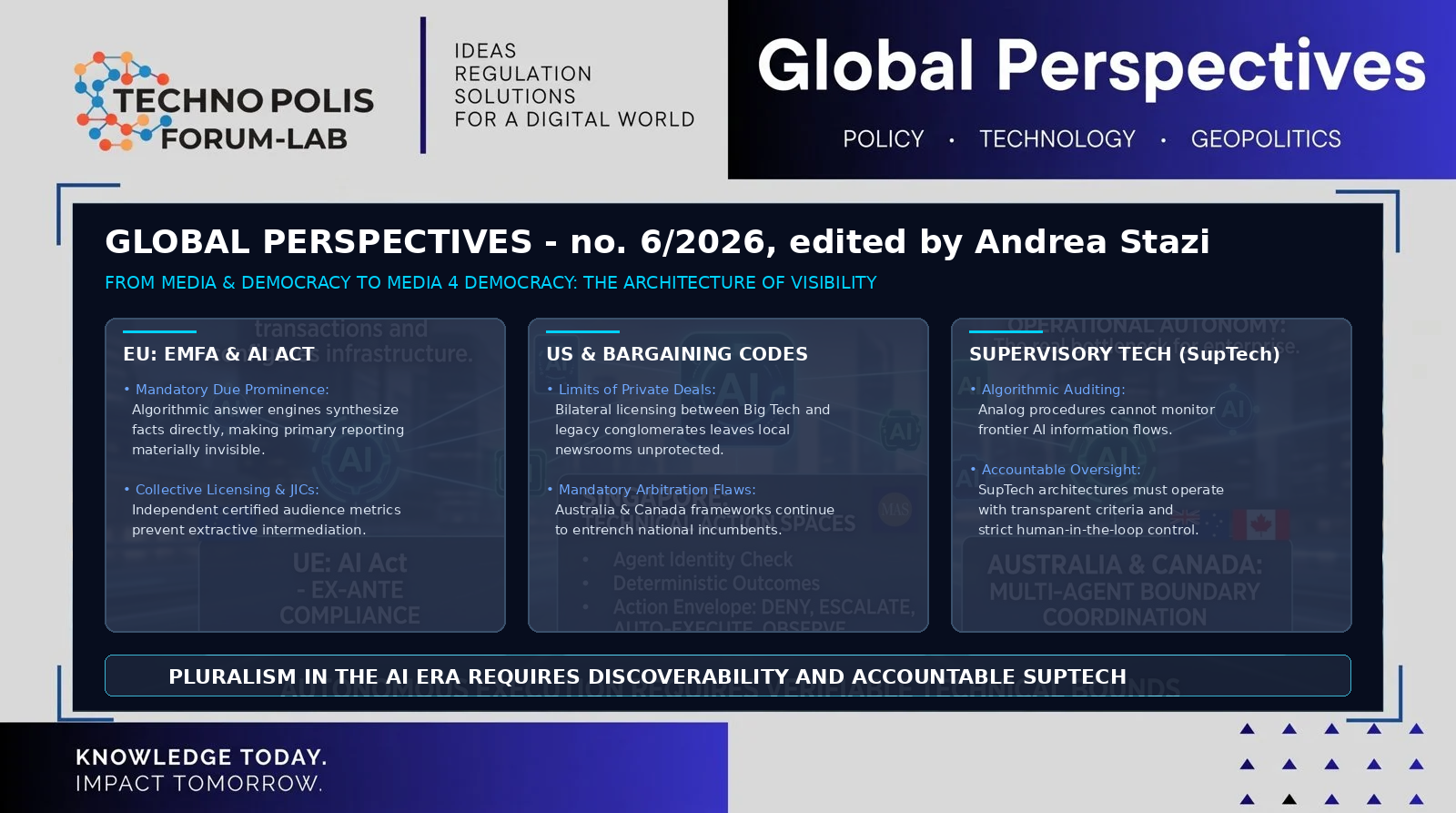
However, as emerging regulatory experiences and insightful constitutional scholarship underline, the digital environment has transformed this dynamic. Scarcity in the digital public sphere no longer concerns the physical space to speak; it concerns attention, discoverability, and the architecture of visibility.
With generative AI models and answer engines increasingly synthesizing reality rather than directing users to primary journalistic reporting, pluralism fundamentally changes nature.
A society may host a vibrant tapestry of hundreds of independent news outlets, yet find them practically invisible if proprietary algorithmic layers bypass them. Pluralism cannot survive merely as a formal right if it is materially diminished by algorithmic opacity.
Transitioning to Media 4 Democracy means purposefully orienting AI toward democratic and economic resilience:
Empowering Society and Civic Agency: Deploying AI to translate dense institutional and legislative processes into accessible, multilingual civic knowledge, thereby fostering informed participation rather than allowing the spread of news deserts and cognitive exclusion.
Rebalancing the Media Economy: Ensuring that the economic value created by high-quality content is not swallowed by extractive intermediation.
In this perspective, it is necessary to recognize the significant dialogue and collaboration efforts already undertaken by several major tech platforms, which have initiated substantial investments in newsroom innovation, signed direct agreements, and demonstrated a growing awareness of the essential value of high-quality, verified journalism.
However, comparative analysis highlights the need to move beyond an approach based solely on bilateral, isolated negotiations: as experience in the United States and other jurisdictions shows, fragmented, direct deals risk disproportionately benefiting large media conglomerates, leaving local and independent outlets without adequate protection and exacerbating market concentration.
Although binding arbitration models - such as Australia's News Media Bargaining Code or Canada's Online News Act - have also sought to rebalance bargaining power, the path forward lies in evolving toward structural, fair, and transparent frameworks.
In this sense, European regulatory options point toward extended collective licensing, combined with close collaboration on independent and certified audience metrics - an area where AGCOM has led the way in Europe by promoting shared measurement systems (Joint Industry Committees) to overcome self-referential metrics and ensure a fair distribution of economic value.
Enhancing Independent Media: Equipping newsrooms with advanced verification, synthesis, and workflow tools, allowing journalists to dedicate more resources to high-value investigative reporting rather than surviving on commoditized clicks.
2. Harmonizing Values and Competitiveness
This brings forward the core dilemma of digital governance: reconciling fundamental values with market competitiveness.
Globally, three distinct governance models compete to define the digital future: the United States prioritizes free-market dynamism, technological scaling, and First Amendment-based deregulation; China combines state-directed control with strategic digital industrial policy; and Europe pursues a constitutional, rights-based framework anchored in fundamental freedoms, systemic risk mitigation, and fair competition.
There is a persistent narrative suggesting an unavoidable trade-off: that democratic systems must either choose a completely deregulated digital market to remain competitive, or accept that protecting fundamental rights will inevitably stifle technological progress.
As international evidence demonstrates, this is a false dilemma. Trust is not a friction on innovation; it is its foundational infrastructure. Comparative empirical research across Western democracies - contrasting the purely commercial media landscape of the United States with the mixed public-commercial systems of Northern Europe such as the United Kingdom, Denmark, and Finland - demonstrates that unregulated market models tend to marginalize hard public affairs news in favor of entertainment, thereby widening knowledge gaps across socio-economic groups.
Conversely, hybrid systems that couple market competition with robust public-interest institutions consistently generate higher civic knowledge, lower information inequality, and superior democratic resilience. Europe’s regulatory framework - from the Digital Services Act and the AI Act to the European Media Freedom Act - proves that clear rules establish a level playing field, algorithmic accountability, and systemic integrity.
Just as European jurisdictions - notably France, the UK, Germany, and Italy - have established due prominence regimes to ensure public-interest audiovisual content remains discoverable on connected interfaces, this regulatory rationale must now adapt to generative search engines and AI aggregators.
However, regulation must not become bureaucratic gridlock. Strengthening European competitiveness calls for regulatory coherence and legislative streamlining - a trajectory highlighted in the debate on the Digital Omnibus - to harmonize overlapping compliance layers while maintaining uncompromised standards of protection.
Crucially, regulatory design must be paired with industrial capacity: investing in European digital public infrastructures, supporting trusted data spaces, and enabling our creative sectors to scale globally based on quality, transparency, and trust.
3. Regulating Innovation with Innovation: Supervisory AI and the Techno Polis Approach
Finally, attention must turn to the institutions entrusted with guaranteeing democratic pluralism.
If content circulation, algorithmic recommendation, and public attention are driven by frontier AI systems, regulatory authorities cannot protect democracy using analog or purely ex-post monitoring tools. An AI-driven democracy demands Supervisory Technology (SupTech): regulators must innovate their own supervisory methods, employing AI to monitor pluralism, audit algorithmic transparency, and detect systemic manipulations in real time.
Yet, as constitutional doctrine rightly emphasizes, supervisory AI must never become an opaque black box itself. If AI is deployed by public authorities to measure balance, representation, and visibility, its criteria must be knowable, its outputs verifiable, and its processes anchored strictly to human oversight and constitutional guarantees.
This is precisely the operational intersection where we focus our work at Techno Polis Forum-Lab, as an international policy content factory and applied AI laboratory. We are dedicated to bridging normative legal principles, constitutional safeguards, and concrete technical solutions.
In this context, we are exploring possible forms of collaboration with regulators, for example to modernize oversight frameworks and address critical issues such as platform governance, online hate speech and the protection of minors.
Our primary focus is evaluating transparent AI architectures that enhance supervisory capabilities, ensuring technological adoption strengthens democratic resilience while staying grounded in human judgment and procedural accountability.
Conclusion
Transitioning from Media & Democracy to Media 4 Democracy means ceasing to treat artificial intelligence merely as an exogenous vulnerability to be managed.
It requires us to actively design and harness AI as a cornerstone of our democratic, economic, and regulatory infrastructure.
By fostering open collaboration, robust public-interest standards, and transparent innovation, we can ensure that digital ecosystems remain inclusive, pluralistic, and vibrant spaces for all.
Selected References
Autorità per le Garanzie nelle Comunicazioni, Relazione annuale 2026 sull’attività svolta e sui programmi di lavoro, Rome, 2026.
Curran, J., Media and Democracy, Routledge, London/New York, 2011.
Curran, J., Iyengar, S., Brink Lund, A., & Salovaara-Moring, I., “Media System, Public Knowledge and Democracy: A Comparative Study”, European Journal of Communication, 24(1), 2009, pp. 5–26.
Da Empoli, S., “Audiovisivo, l'AI cambia filiera e regolazione: l'UE cerca una nuova rotta”, Agenda Digitale, July 2026.
European Commission, The European Media Industry Outlook, Directorate-General for Communications Networks, Content and Technology, EU Publications Office, September 2025.
European Parliament, Generative AI and Copyright: Training, Creation, Regulation, Study requested by the JURI Committee, PE 774.095, Brussels, July 2025.
European Parliament, Resolution on Copyright and Generative Artificial Intelligence – Opportunities and Challenges, 2025/2058(INI), March 2026.
European Parliament, Resolution on European Technological Sovereignty and Digital Infrastructure, 2025/2007(INI), January 2026.
European Union Intellectual Property Office, The Development of Generative Artificial Intelligence from a Copyright Perspective, Executive Briefing, May 2025.
Netherlands Scientific Council for Government Policy, Media Matters: Towards New Safeguards for Their Democratic Functions, Research for Policy, Springer, 2026.
Pollicino, O., “Relazione Agcom 2026: Quando la tutela del pluralismo passa per l'AI”, Fortune Italia, September 2026.
Stazi, A., “Audience online: la svolta AGCOM oltre il modello dell'SDK unico”, Agenda Digitale, March 2026.
Stazi, A., “Digital Omnibus e competitività europea: una svolta necessaria”, Agenda Digitale, April 2026.
The Data Tank (Colom, A., & Poblet, M.), Media, Democracy and Generative AI: A Critical Juncture, Research Report & Policy Review, May 2026.