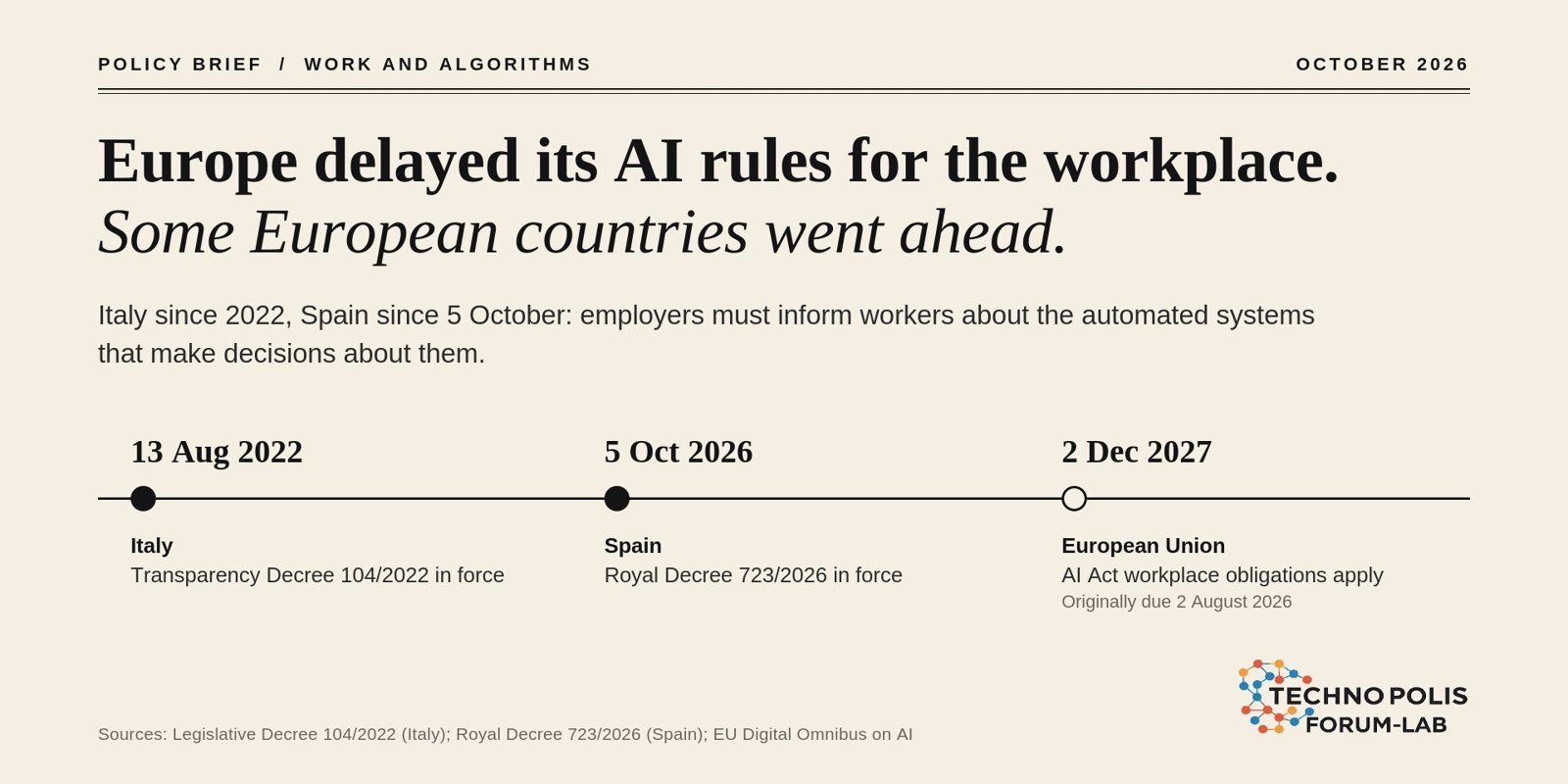
In July, the European Union postponed the AI Act's obligations for the high risk systems listed in its Annex III, a category that includes AI used to make decisions about workers. They were due in August 2026 and now apply from 2 December 2027. On 5 October, Spain brought into force a rule that covers part of the same ground.
Royal Decree 723/2026, published in the Spanish official gazette on 15 September, sets out what employers must tell workers in writing about their contract and working conditions. One of the new items, in Article 3.2(k), is the existence of algorithmic or automated decision making systems. Where such systems are used to decide on working conditions, the information must include their guidelines, criteria and operating rules. The decree spells out the decisions it means: working hours and their distribution, task allocation, pay, career progression, place of work and termination of the contract.
The decree itself singles out this item for its novelty. Since 2021, Spanish law has given worker representatives a collective right to know the parameters, rules and instructions behind algorithms that affect working conditions, under Article 64.4(d) of the Workers' Statute. The change is that the information now goes to each worker, individually and in writing.
The obligation applies to employment relationships lasting more than four weeks, and the information has to be provided before work starts. Any later change must be communicated in writing as soon as possible and at the latest on the day it takes effect; since the duty covers every item in Article 3.2, that includes changes to the algorithm information. Staff already employed on 5 October can request the information, and the employer then has thirty working days to provide whatever the worker does not already hold.
The form is regulated too. The information can be on paper or in electronic format, provided the worker can store and print it, and the employer must keep proof that it was sent or received. For workers with disabilities it has to be accessible and understandable. Several items can be covered by a precise reference to a law or a collective agreement, but the algorithm item is absent from that list, so it has to be described.
The preamble grounds the provision in the AI Act, citing among others the articles that require deployers to inform workers and the people affected by high risk systems. The AI Act leaves room for this: its Article 2(11) allows member states to keep or introduce rules more favourable to workers on the use of AI by employers. So while the European obligations for AI in the workplace start in December 2027, employers in Spain already have to disclose in writing the existence of these systems and, where they decide working conditions, the rules they apply.
In practice the decree starts with an inventory. Before a contract begins, someone has to know which tools allocate shifts or tasks, calculate pay, score people for promotion or select them for dismissal, and be able to describe in plain language what each one weighs. The wording covers algorithmic or automated systems, so on a plain reading it reaches beyond AI to automated rules of any kind.
There are limits worth knowing. The text asks for guidelines, criteria and operating rules, a description of how a system decides, and says nothing about handing over the model or its code. The Ministry of Labour was to publish a template information document within twenty days of the decree's publication, and the decree states that the obligation applies regardless of when the template appears.
For organisations outside Spain, the lesson is about timing. The European calendar for workplace AI moved, and national law moved ahead of it. Companies with staff in Spain are already inside the new regime, and employers across the EU that use high risk AI on their staff face a similar duty to inform from December 2027. The question is the same in both cases: can you explain in writing what your systems decide about people, and how?
That question is easier to answer when the AI itself keeps its sources visible. Our private AI environment is dedicated to each organisation and hosted entirely in Europe, and every answer it gives carries numbered citations back to the documents it used. We will be at Dubai AI Festival on 26 and 27 October, at the Dubai World Trade Centre, stand S117 in the Startup Zone. If you want to talk about AI that can be explained to the people it affects, come and find us.