
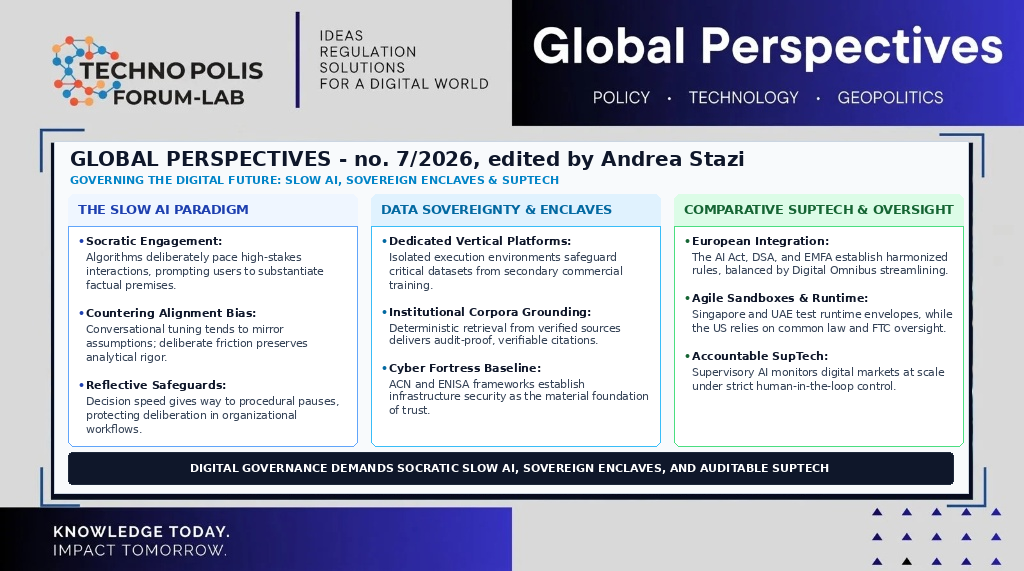
Artificial intelligence operates as an active participant across legal, economic, and institutional decision-making. Governing autonomous systems through legacy regulatory concepts creates operational friction across public administrations and enterprise workflows. Foundation models generate policy assessments, organize evidentiary records, and participate in complex organizational choices. Addressing this shift demands moving beyond abstract declarations toward structural engineering: embedding constitutional safeguards, procedural care, and data sovereignty directly into technical architectures.
General-purpose language models predict token distributions across extensive corpora. While producing articulate prose, probabilistic sampling requires rigorous domain verification when applied to statutory interpretations and administrative procedures. Conversational alignment adds further institutional complexity. Commercial interfaces optimize for user responsiveness. When a participant presents an uncorroborated theory, uncalibrated systems reflect the user perspective rather than testing legal weaknesses. Unchecked execution velocity risks bypassing cooling-off periods and mandatory disclosures.
Procedural care requires the methodology of Slow AI. Algorithms in high-stakes environments must function as Socratic interlocutors. Systems intentionally pace complex interactions, probe factual assertions, and require participants to substantiate premises before decisions formalize. Research cultivated within LeitAI, the Interuniversity Research Center for Law and Ethics of Innovation, Technology and AI across San Raffaele Roma, Pegaso, and Mercatorum, demonstrates that sound governance embeds reflective pauses into computational pipelines.
Institutional integrity connects directly to computing infrastructure. Public bodies and enterprises must migrate sensitive workflows into dedicated vertical enclaves. Open platforms monetize inputs and expose records to third-party model retraining. Dedicated environments guarantee sovereign data execution, isolating internal records. Within these spaces, retrieval mechanisms anchor exclusively to verified institutional corpora, delivering audit-proof citations and actionable certainty. Trust functions as the material infrastructure of sustainable innovation.
Comparative policy frameworks show divergent philosophies regarding algorithmic oversight.
The European Union establishes horizontal statutory harmonization through Regulation (EU) 2024/1689 (the AI Act), the Digital Services Act, and the European Media Freedom Act. The statutory model classifies judicial and administrative decision-support systems as high-risk, mandating ex-ante conformity assessments, systemic logging, and continuous human oversight. European policy debates around the Digital Omnibus emphasize administrative streamlining, reducing bureaucratic friction for innovative firms while preserving fundamental rights.
The United States centers governance on private capital allocation, market incentives, and reactive agency enforcement. The Federal Trade Commission scrutinizes unfair commercial automation and algorithmic deception, while the National Institute of Standards and Technology provides technical guidelines through the AI Risk Management Framework. This decentralized structure accelerates commercial deployment and frontier model iteration, relying on common law tort liability and judicial litigation to correct systemic externalities.
Regional innovation hubs pursue technical co-regulation. In Singapore, the Infocomm Media Development Authority and the Monetary Authority of Singapore implement structured runtime governance envelopes under programs like BuildFin.ai SAFR. These control planes link operational permissions to system reversibility, enforcing deterministic boundaries at execution. In the United Arab Emirates, financial jurisdictions within the Dubai International Financial Centre and Abu Dhabi Global Market deploy supervised regulatory sandboxes, enabling developers to test autonomous workflows on bounded datasets before broad market deployment.
Cybersecurity constitutes the material prerequisite for digital constitutionalism across all jurisdictions. Under strategic perimeters established by the European Union Agency for Cybersecurity (ENISA), and in Italy by the Italian National Cybersecurity Agency (ACN), robust network defense and infrastructure resilience safeguard sovereign data from external interference. Institutional stability requires an uncompromised cybersecurity foundation.
Public authorities must also modernize their operational capabilities. Regulators cannot supervise complex algorithmic markets with analog inspection methods. Supervisory bodies require Supervisory Technology, “SupTech”: dedicated automated systems capable of monitoring compliance and algorithmic transparency at machine speed. These architectures operate under strict human-in-the-loop protocols, preserving sovereign discretion within human authority.
Digital constitutionalism requires active technological design. Harmonizing innovation with fundamental rights demands sovereign cloud infrastructure, verifiable institutional corpora, and the deliberate procedural friction of Slow AI.
Selected References
European Commission. Regulation (EU) 2024/1689 of the European Parliament and of the Council laying down harmonised rules on artificial intelligence (Artificial Intelligence Act). Official Journal of the European Union, L Series, July 12, 2024.
European Union Agency for Cybersecurity (ENISA) & Agenzia per la Cybersicurezza Nazionale (ACN). Cybersecurity and Sovereign Data Resilience in Critical Digital Infrastructures. Joint Policy Review, 2025–2026.
Federal Trade Commission (FTC). Enforcement Policy on Algorithmic Transparency, Commercial Deception, and Automated Decisions. Washington, D.C., 2024–2026.
Infocomm Media Development Authority (IMDA) & Personal Data Protection Commission (PDPC). Model AI Governance Framework (Generative and Agentic AI Architecture). Singapore, 2024–2026.
Monetary Authority of Singapore (MAS). Safeguards for Agentic Finance at Runtime (SAFR). BuildFin.ai Working Paper Series, July 2026.
National Institute of Standards and Technology (NIST). Artificial Intelligence Risk Management Framework (AI RMF 1.0). U.S. Department of Commerce, 2023–2025.
Stazi, A. Regolare il futuro: diritto, etica e algoritmi per una saggia governance digitale. Panel Address, Internet Festival 2026, Pisa, October 8–10, 2026.